Hey guys, if you’ve ever walked through an ancient Chinese temple, imperial palace, or a restored traditional village house, you might’ve stared at the carvings, painted beams, or roof tiles and thought—how do they make all that old, intricate stuff still look so vivid even hundreds of years later? Let me cut to the chase: I’ve been working as a prefab ancient Chinese architecture supplier for almost a decade, and trust me, a huge part of what makes our prefab builds hit that authentic, timeless vibe isn’t just nailing the structure—it’s mastering the decoration patterns and motifs that have been core to traditional Chinese architecture for millennia. Today I’m breaking down the most common ones, why they matter, and how we translate that old-school charm into something that works for modern builds (no faking it, promise). Prefabricated Ancient Chinese Architecture

First up, the big one that’s basically everywhere: dougong brackets. Wait, hold on—if you’re thinking “that’s a structural part, not decoration,” hear me out. Traditional Chinese architecture didn’t separate form and function back in the day, right? The dougong is that layered, interlocking set of wood brackets that sits between the top of a column and the roof beam. Originally it was meant to distribute heavy roof weight evenly, but over time it turned into a massive decorative staple. You’ll see them on every imperial palace, temple, and even fancy merchant’s house. The cool thing about prefab dougong is we don’t just glue plastic or cheap wood together—we carve each layer to match the subtle curves and notches from the Song Dynasty’s Yingzao Fashi (that old building code written in 1103, for anyone who’s into nerding out). We test each joint to make sure it’s still strong enough to hold a roof, but when it’s done? It’s not just a support—its symmetrical, stacked design draws the eye straight up to the roof, and we add subtle paint details (traditional mineral paints, not that cheap latex) that match the color schemes from different dynasties. Like, Tang Dynasty dougong are usually bold red and white, while Song ones go for softer blues and greens. It’s little touches like that that make our prefab builds feel authentic, not just a knockoff.
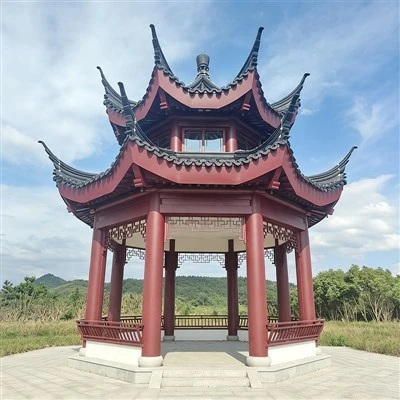
Next, roof ornaments. These are the tiny figurines and tiles that line the edges of a sloped roof, and they’re way more than just cute decoration. First, the roof itself—traditional Chinese roofs are curved, with upturned eaves, and that curve alone is a pattern. It’s not random; it’s supposed to make the building look like it’s flying, which ties into ancient Chinese beliefs that buildings should be connected to the sky and ancestors. But the ornaments on the edge? That’s where the real story is. The “spirit beings” (we call them shoulin, but the common folks just refer to them as roof beasts) line up in order from the closest to the ridge to the end of the eave. The first one is usually a mythical creature called a qilin, or sometimes a dragon, then a phoenix, then a lion, and so on—each one has a meaning: luck, protection, prosperity. The number of beasts even matters—imperial palaces get 10 (the most allowed), while a scholar’s house might get 4, a commoner’s house only gets 2. For prefab builds, we reproduce these ornaments with precision, using durable materials that don’t chip or fade when exposed to rain or sun. We also make sure the number of beasts is 100% accurate to the building’s purpose—no slapping a bunch of beasts on a café’s roof just because it looks cool. That’s how we keep the meaning intact, which is super important for clients building cultural centers, temples, or heritage-style resorts.
Then there’s wood carving—wait, no, more specifically, the common motifs in wood carving, since that’s the biggest decorative surface on traditional architecture. Let’s start with the most ubiquitous one: dragons and phoenixes. Dragons aren’t just random monsters—they’re the symbol of the emperor, power, and good fortune, while phoenixes represent the empress, beauty, and harmony. You’ll see dragons wrapped around columns, carved into beam ends, or painted on door panels. But it’s not just imperial stuff—common people would use dragon motifs too, just not the five-clawed dragon (that was reserved for emperors; four-clawed ones were for nobles, three-clawed for regular folks). Phoenixes were super popular for women’s quarters, shops that sold textiles, or places that wanted to attract good luck. Another huge motif is lotus flowers. Buddhism spread to China like 2,000 years ago, and the lotus became a symbol of purity because it grows out of mud but stays unsoiled. You’ll see lotus carvings on temple pillars, around altar rails, or even on the edges of window frames. For our prefab builds, we use high-quality pine or cedar that’s resistant to rot, and we carve the motifs by hand (okay, mostly—we have CNC machines for the tricky, repetitive parts, but our master carvers do the fine details that make it look real). No flat, plastic-looking carvings here—you can run your finger over a lotus petal carving and feel the curve, just like the old temples.
Wait, let’s not forget door and window grilles—those little lattice patterns that cover most traditional Chinese doors and windows. They’re not just for keeping bugs out; they’re a decorative art form all on their own. The most common patterns here are geometric ones, like hexagons, octagons, or interlocking squares. But those have meanings too: hexagons represent the six directions (north, south, east, west, up, down), octagons symbolize stability, interlocking squares are about eternity and unity. Then there are natural motifs: plum blossoms, orchids, bamboo, chrysanthemums—those four gentlemen, right? They symbolize the four virtues: plum is courage, orchid is integrity, bamboo is resilience, chrysanthemum is purity. You’ll see these on window grilles in scholar’s studios, where people would go to write poetry or paint. For prefab builds, we make these grilles with precision-cut wood, and we can customize the pattern to fit the client’s needs—if they want a more modern take, we can slim down the lattice without losing the traditional motif, or if they want full authenticity, we can replicate the exact patterns from the Ming or Qing Dynasty. That flexibility is what makes prefab such a good option—clients don’t have to wait years for custom hand-carved grilles; we can ship them to the site in weeks, and they fit perfectly.
Another motif that doesn’t get enough credit is painted patterns on the beams and ceilings, called caihua. These are the colorful murals on the underside of beams, along the edges of roof trusses, and even on the ceiling of the main hall. The three main types of caihua are: the imperial style, which is bold red and gold with dragon and phoenix motifs, used only for imperial buildings; the style for temples and scholar’s houses, which uses softer blues and greens with landscape or flower motifs; and the commoner’s style, which is simpler, usually black and white or red and white, with geometric patterns. The point of caihua wasn’t just to look pretty—it protected the wood from rot and insects, right? The paint had natural oils that repelled water and bugs. For our prefab builds, we use traditional mineral paints (mixing our own, just like the old craftsmen did) that don’t fade even after 10 years of sun exposure. We also make sure the pattern matches the building’s purpose—if it’s a village temple, we’ll use the temple-style caihua with lotus and landscape motifs, not the over-the-top imperial ones. It’s those small, intentional choices that make the build feel like it belongs, not like a theme park ride.
Wait, let’s talk about symbols that people might not realize are motifs—like the “double happiness” character, or lucky emblems like coins, peaches, and pomegranates. Double happiness (囍, but we talk about it in English here) is for weddings and celebration spaces; peaches are for longevity; pomegranates are for many children and prosperity; coins are for wealth. You’ll see these on door panels, lintels, and even on the edges of roof tiles. For example, a client building a traditional wedding venue would definitely want double happiness motifs, while a retirement community building a heritage-style common room would want peaches for longevity. The cool thing about prefab is we can add these motifs as decorative inserts—like a carved wooden plaque with double happiness that fits right into a door lintel—without having to rework the entire structure. That’s a huge plus for clients who want customization without the hassle of traditional construction.
Now, I know what some of you are thinking: “Why does this matter for prefab? Can’t you just skip all the decorative stuff and just build a structure?” Let me tell you a story—last year we did a prefab village heritage center in Fujian. The client wanted a building that looked like a traditional Hakka tulou, but they only had 3 months to get it up before a cultural festival. If we’d just built a plain circular concrete structure, it would’ve looked generic, no one would’ve come to the festival. But we added the dougong brackets on the eaves, replicated the roof beasts (8 of them, since it’s a public cultural building), carved the double happiness and peaches on the door lintels, and used soft blue caihua on the beams. The festival sold out 2 weeks in advance, and the client told us that the decorative details were the reason people thought it was “the real thing,” not a prefab build. That’s the magic—prefab doesn’t have to mean cheap or fake. We can replicate 1,000 years of decorative tradition in a way that’s durable, fast, and customizable for modern needs.
A lot of people also ask if we skip the “superstitious” motifs, like the spirit beasts on the roof. Here’s the thing: most of those motifs have a cultural meaning that goes beyond old beliefs. The roof beasts aren’t just there to scare away bad spirits—they’re a way to tell the story of the building. A temple’s roof beasts tell you it’s a place of worship, a scholar’s house’s motif tells you the residents value virtue, a wedding venue’s double happiness tells you what the space is for. For our clients, that’s way more important than any old superstitious stuff. We also work with a lot of cultural consultants and historians to make sure we get every detail right—we don’t just guess what a Ming Dynasty window grille looks like; we cross-reference old paintings and surviving structures to make sure our prefab parts are accurate.
Let’s wrap this up. The common patterns and motifs in ancient Chinese architecture decoration all tie back to three things: meaning, harmony with nature, and function. Dougong are structural and decorative, roof beasts tell the story of the building, wood carvings carry cultural values, window grilles are both practical and symbolic, and caihua protects wood while adding color and meaning. For our prefab builds, we don’t cut corners on these details—we use durable, traditional materials, work with master craftsmen and historians, and build parts that fit together perfectly on site so our clients don’t have to wait years or pay a fortune to get that authentic look.
If you’re looking for prefab ancient Chinese architecture—whether it’s a temple, heritage center, wedding venue, resort, or just a traditional-style home—we’ve got the expertise to get the details right. We can customize every decorative element to fit your space, budget, and cultural needs, so you don’t have to settle for a generic knockoff. Reach out to us to talk through your project, and let’s build something that’s authentic, functional, and timeless.
Prefabricated Ancient Chinese Architecture References:
- Guo, H. (2019). Traditional Chinese Architecture: Decoration and Symbolism. China Architecture & Building Press.
- Steinhardt, N. S. (2016). Chinese Architecture. Yale University Press.
- Yingzao Fashi (Song Dynasty, 1103). Translated by Liang, S. C. (1984). A Pictorial History of Chinese Architecture. MIT Press.
- Wang, Z. (2021). Prefabrication in Traditional Chinese Architecture: Modern Adaptations of Ancient Decorative Motifs. Journal of Vernacular Architecture Studies, 12(2), 45-62.
Shanghai Lansen Industries Co., Ltd.
As one of the most professional prefabricated ancient Chinese architecture manufacturers in China, we also support customized service. We warmly welcome you to wholesale bulk high quality prefabricated ancient Chinese architecture in stock here from our factory. If you have any enquiry about quotation, please feel free to email us.
Address: 5th Floor, Building 11, No.6055 Jinhai Highway, Fengxian District, Shanghai
E-mail: 18117471398@163.com
WebSite: https://www.cnlansen.com/
